All Categories
Featured

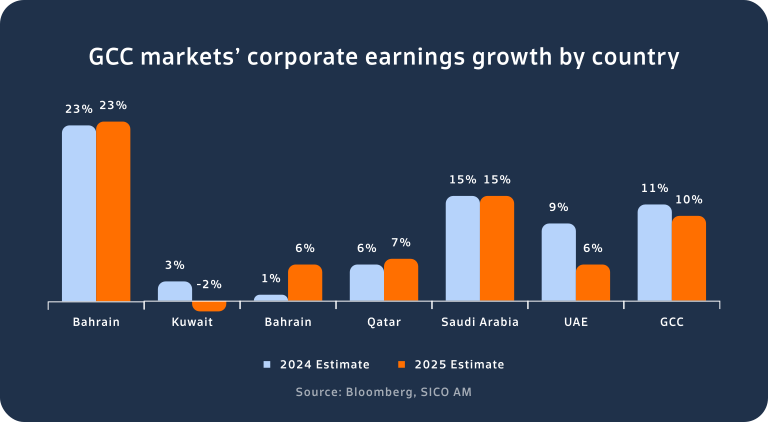
Reviewing Market Growth within the GCC
Looking ahead, optimistic projections for a healthy IPO pipeline across the Gulf over the next 12-18 months appear. This optimism is buoyed by reducing geopolitical tensions, which have formerly affected market self-confidence. Even typically quieter markets are showing signs of activity, exemplified by Kuwait's anticipation of a rare convenience-store IPO.
In general, as regional markets continue to evolve, they show the broader financial and geopolitical narratives at play, providing both difficulties and opportunities for investors engaging with the Middle East.
ESG Metrics: What Gulf Investors Need to Know Right Nowis for Stock/ Commodity/ Currency/ Forex/ Crypto Market Details functions is not a Monetary Advisor/ Influencer and does not provide any trading or financial investment abilities/ tips/ suggestions via its website/ directly/ social networks or through any other channel.Disclaimer/ Disclosure and Personal Privacy Policy/ Terms apply to all users/ members of this website. The chain impacts of increasing stress in the Middle East arising from the United States and Israeli attacks on Iran and Iran's retaliation have actually put pressure on the global economy while increasing threats as reflected in the stock exchange efficiency, monetary policies, and danger premiums of Gulf nations. Stress in the Middle East remained high on the 20th day, following US and Israeli attacks on Iran and Iranian retaliation.
Comparing Market Growth within the GCC
With brand-new attacks, optimism that the area's stress would be dealt with in a short period of time faded, leaving concerns about the possible long-lasting results of the disputes on economies. Iran's retaliation, targeting Gulf countries and tactical centers, has a direct effect on market dynamics. Major changes happened in the markets of Gulf countries with the increasing risk understanding, while sharp boosts stood out in country danger premiums.
The nation's risk premium increased by approximately 140 basis points to 392. Bahrain's risk premium increased by 84 basis points to 297, while Qatar's risk premium moved up by 13 basis points to 45 in the exact same period.
Saudi Arabia's danger premium visited approximately 2 basis indicate 80.4 in this process. Analysts said Saudi Arabia experienced reasonably less impact from this situation thanks to its strong foreign exchange earnings. Stock exchange in the Gulf followed a mixed trend, while the UAE stock exchange became the one that fell the most because the beginning of the disputes that started with the United States and Israeli attacks on Iran and infected other nations in the region.
Shares of petrochemical and energy business in the area, following a primarily favorable pattern in parallel with the rise in oil prices, slowed the decline in the indices. Offering pressure continued to work in the markets in the UAE, Bahrain, Qatar, and Kuwait, where extreme airstrikes occurred. Concerns about the country's security triggered a drop in property and investment firm shares on the UAE stock market.
Nevertheless, airstrikes on energy facilities and lines, which heightened following market closures, were not yet priced into regional markets. Targeting some oil centers in the conflicts and slowing down maritime traffic in the Strait of Hormuz, which has critical value for oil shipments, increased energy expenses and sustained global inflation risks upwards.
Will GCC Markets Lead in 2026?
The Central Bank of the UAE (CBUAE) and the Central Bank of Kuwait (CBK) revealed that their banking systems stayed durable. The CBUAE authorized the "Financial Institutions Resilience Package," which is supported by the main bank's one trillion dirhams ($ 270 billion) property and intends to enhance the banking sector's stability in the face of remarkable conditions in global and regional markets.
The 5 main pillars of the bundle objective to increase banks' access to financial liquidity and flexibility to support the UAE economy. Handling forex reserves exceeding one trillion dirhams ($ 270 billion) and a financial base coverage ratio of 119%, the bank validated the strong fundamentals of the UAE's 5.4 trillion dirhams ($ 1.47 trillion) banking sector.
A declaration from the Reserve bank highlighted that regional banks continued to provide all banking services efficiently and dependably, even under current conditions. The statement stated this success arised from banks strengthening their threat management systems, developing organization connection and emergency strategies, improving their digital facilities, and conducting routine workouts replicating possible circumstances in line with the Reserve bank's directives.
Goldman Sachs, among the major United States banks, projected that the economies of Qatar and Kuwait could face a 14% contraction as oil shipments would decrease in a circumstance where the Strait of Hormuz remained closed for 2 months.

Latest Posts

Key Equity Trends Across the GCC

Reshaping Middle East Sectoral Expansion for Growth

Benefits of Diversified Asset Allocation in 2026