All Categories
Featured

Key Equity Market Strategies for Regional Investors
Table of Contents
Capital flows into the GCC have been on the rise over the last few years. In the last few years, foreign direct financial investment Gulf reached an all-time high as governments went complete steam ahead with their facilities, tidy energy, transportation passages, and advanced production zone tasks. This also reflects broader foreign investment trends in Gulf region 2026.
Just by their moves, they have become a beacon for global investors seeing that the area is dedicated to long-lasting financial improvement. A lot of these programs connect directly to major Gulf facilities projects. These new industries, far from oil, can be next to none in terms of returns for those venturing into them with a long-lasting view and exploring Gulf financial investment opportunities that continue to broaden in scope.
Barely any growth comes without its own set of problems. The Gulf economies 2026 are still oil-dependent and vulnerable to market changes.
This is an area where GCC diversification effect on investors 2026 ends up being more visible. Diversification likewise varies from one part of the area to another. The big economies like Saudi Arabia and the UAE are advancing quickly, whereas the small members of the GCC may still be at the beginning point.
Besides, the investor's photo is not complete without thinking about the problems of geopolitical unpredictability and international macroeconomic shifts. The trade wars, energy transitions, and modifications in global demand can influence capital circulations into and out of the Gulf. This ties carefully to geopolitical risks Gulf, which are never ever far from strategic assessments.
International Capital Opportunities across the GCC
These are the real growth motorists that are emerging, and they are electrifying portals for the investors who desire to be exposed to non-hydrocarbon activities. These advancements feed into wider Middle East financial trends 2026 and shape what financiers need to watch in Gulf economies 2026. Changes in policy regarding foreign ownership, investment incentives, and trade policies will be the primary elements that affect business environment.
Oil stays a key profits source for numerous Gulf states. Stable currencies are one of the primary functions of many Gulf economies 2026.
The region, which was mainly reliant on oil incomes, is now slowly changing into a varied economic landscape with several engines of growth. The GCC financial outlook is intense due to the growth of non-oil sectors, continuous reform efforts, and rising foreign financial investment. This is supported by consistent foreign investment trends in Gulf area 2026.
The dangers have not vanished, prudent decision making will help bring to light the strong capacity for returns connected to growing Gulf investment chances. Read More Blog Site: Click Here.
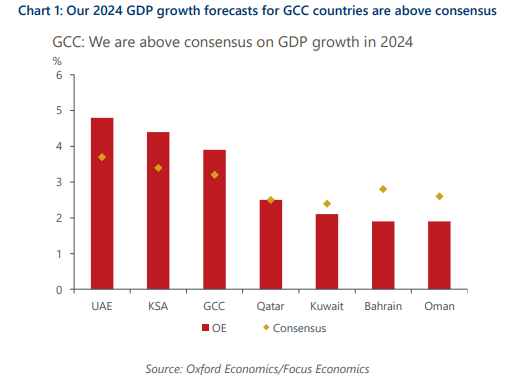
RIYADH: Economies throughout the Gulf Cooperation Council are anticipated to grow 4.4 percent in 2026, accelerating to 4.6 percent in 2027, driven by rising non-oil activity in nations consisting of Saudi Arabia, according to an analysis. In its International Economic Potential customers report, the World Bank stated the Kingdom's genuine gdp is forecasted to grow 4.3 percent in 2026 and 4.4 percent in 2027, up from an expected 3.8 percent in 2025.
Evaluating Regional Investment Potential for 2026
The World Bank's newest forecast broadly aligns with the International Monetary Fund's October outlook, which forecasts Saudi Arabia's GDP to grow by about 4 percent in both 2025 and 2026. In its newest report, the World Bank stated: "Development in GCC countries is forecast to increase to 4.4 percent in 2026 and 4.6 percent in 2027, primarily reflecting a stable growth of non-hydrocarbon activity, in addition to a more rise in hydrocarbon production." It added: "The strengthening of non-hydrocarbon activity accounting for more than 60 percent of GCC nations' total GDP is forecasted to be supported by expected large-scale financial investments, consisting of in Kuwait and Saudi Arabia." Expanding the non-oil sector remains a core objective of Saudi Arabia's Vision 2030 program, as the Kingdom continues efforts to decrease its enduring reliance on crude earnings.
The region, which was generally based on oil incomes, is now slowly changing into a varied financial landscape with numerous engines of growth. The GCC financial outlook is bright due to the expansion of non-oil sectors, continuous reform efforts, and rising foreign investment. This is supported by stable foreign financial investment patterns in Gulf region 2026.
The risks have actually not vanished, sensible choice making will assist bring to light the strong capacity for returns linked to growing Gulf financial investment chances. Learn more Blog Site: Click Here.
RIYADH: Economies across the Gulf Cooperation Council are anticipated to grow 4.4 percent in 2026, speeding up to 4.6 percent in 2027, driven by increasing non-oil activity in countries including Saudi Arabia, according to an analysis. In its Global Economic Potential customers report, the World Bank said the Kingdom's real gdp is projected to grow 4.3 percent in 2026 and 4.4 percent in 2027, up from an anticipated 3.8 percent in 2025.
2026 Regional Economic Projections
The World Bank's newest forecast broadly aligns with the International Monetary Fund's October outlook, which forecasts Saudi Arabia's GDP to grow by about 4 percent in both 2025 and 2026. In its latest report, the World Bank said: "Growth in GCC nations is anticipated to increase to 4.4 percent in 2026 and 4.6 percent in 2027, mainly showing a constant expansion of non-hydrocarbon activity, in addition to a further increase in hydrocarbon production." It included: "The strengthening of non-hydrocarbon activity accounting for more than 60 percent of GCC nations' total GDP is forecasted to be supported by expected large-scale investments, including in Kuwait and Saudi Arabia." Expanding the non-oil sector stays a core goal of Saudi Arabia's Vision 2030 agenda, as the Kingdom continues efforts to decrease its enduring dependence on unrefined incomes.

Latest Posts

Key Equity Trends Across the GCC
Reshaping Middle East Sectoral Expansion for Growth

Benefits of Diversified Asset Allocation in 2026