All Categories
Featured


Future Regional Financial Forecasts
Dangers are slanted to the drawback. In the occasion of an extended conflict, the current effect on the region will be compoundedthrough raised energy and food costs, declining trade, tourism and remittances, increased financial pressures, and displacement. "The existing crisis is a plain suggestion of the work ahead for the area: not just to weather shocks, however to reconstruct more durable economies with stronger macroeconomic basics, innovate and enhance governance, buy infrastructure, and improve employment-creating sectors," said.
With peace and the right action, countries can develop the organizations, abilities and competitive sectors that produce chances for people." With this long-term vision in mind, the report takes a close look at the region's potential for commercial policy government actions to increase strategic business activity as a chauffeur of economic growth and task production.
Federal governments in the area have actually adopted commercial policy at a high rate in the last decade, frequently through sovereign wealth funds and state-owned enterprises, however the outcomes have been mixed. The report highlights the important need for strong organizations and cautious targeting of policies. "As nations face the heavy toll of today dispute, it is very important to also not forget the work required for long-lasting peace and success," said.
Future GCC Economic Forecasts
Q2 2026: The ICAEW Economic Update Middle East, is a quarterly financial projection for the region prepared straight for the financing occupation. The GCC economy deals with a marked contraction this year pending details of the US-Iran contract to end the war. We anticipate energy flows, tourism and financier belief to slowly normalise as war disturbances diminish.

The interim arrangement in between the US and Iran is a substantial action towards reaching a full-blown offer. A full return to normality in the Strait of Hormuz will likely take time, but the danger of a recession-inducing oil cost spike has decreased. Global GDP is expected to grow by 2.4% this year, 0.2 ppt less than we projected 3 months earlier, and 3.1% in 2027.
The Impact of Interest Rates on UAE Real Estate TrustsWe anticipate a 4.1% contraction in Middle East GDP this year (versus forecasted 3.6% expansion before the war), higher than the decline in the first year of the Covid pandemic. Kuwait, Iran, Iraq and Qatar stick out as the hardest hit, owing to their failure to prevent the disruption to regional shipping, war-driven facilities damage and tourism losses.
Beyond Reserves: How SWFs Drive Innovation in the Middle EastOur 2026 outlook for the GCC is weaker than 3 months earlier, with GDP forecast to agreement by 2.4% compared to a 0.2% decrease predicted previously. We expect Oman and Saudi Arabia to be the least negatively affected by the fallout from the dispute, with both economies continuing to broaden this year.
The economic damage sustained in the last few months is substantial. Saudi GDP data for Q1 showed growth slowed to 3% y/y, with non-oil activities broadening by 2.9%, the weakest speed since the Covid pandemic. On a seasonally adjusted basis, GDP contracted 1.2% q/q, driven by a 6.8% fall in oil activities as the Strait of Hormuz disturbance struck late in the quarter.
Middle East Equity Market Trends in 2026
Aside from Oman, all GCC producers along with Iran and Iraq have actually suffered extensive oil and gas production losses considering that the start of the conflict. Might data reveal regional production nearly halved from pre-war levels, with the decrease deepening relative to March and April. Rerouting efforts, consisting of by Saudi Arabia through the East-West Pipeline and the UAE through the Habshan-Fujairah pipeline, have actually helped prevent an even bigger plunge in output.
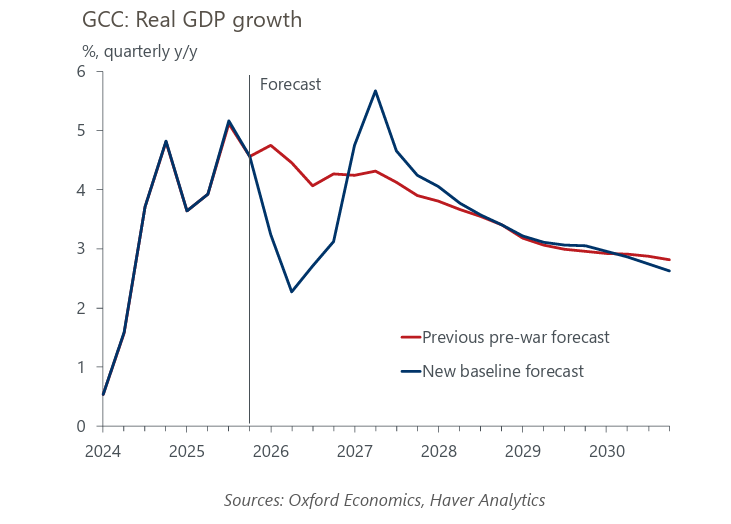
We anticipate GCC oil sector output to contract by 14.5% this year, which will mark the steepest decrease in a number of years. We then expect a 23.5% rebound next year, driven mainly by normalisation from a severely depressed base. Meanwhile, oil prices have actually been volatile, easing below $85 per barrel as the interim contract was announced.
In the medium term, we expect oil costs to be a little lower than our pre-war baseline, as the UAE's departure from OPEC+ permits for a steady increase in its output towards the 5mn barrel each day production target when trade normalises. Versus this background, the UAE will speed up the building and construction of a brand-new West-East pipeline that must double the capability of export through Fujairah.
The May PMI surveys reported output development reaching its strongest level in 3 months, driven mainly by enhanced domestic demand. Nevertheless, they remain below long-run averages, with weak export orders and rate pressures from higher material and transportation expenses are a common theme. Overall, we anticipate a 1.1% contraction in GCC non-energy sectors this year (compared to 4.2% growth pre-war) and a steady recovery over the remainder of the decade.

Latest Posts

Key Equity Trends Across the GCC

Reshaping Middle East Sectoral Expansion for Growth

Benefits of Diversified Asset Allocation in 2026